Utopia, Silence and Finding Your Voice
How You Find Your Voice Episode 8
In this episode of the How You Find Your Voice podcast, I speak with writer, essayist and clinical arts therapist Susanna Crossman about her memoir Home Is Where We Start and her novel The Orange Notebooks.
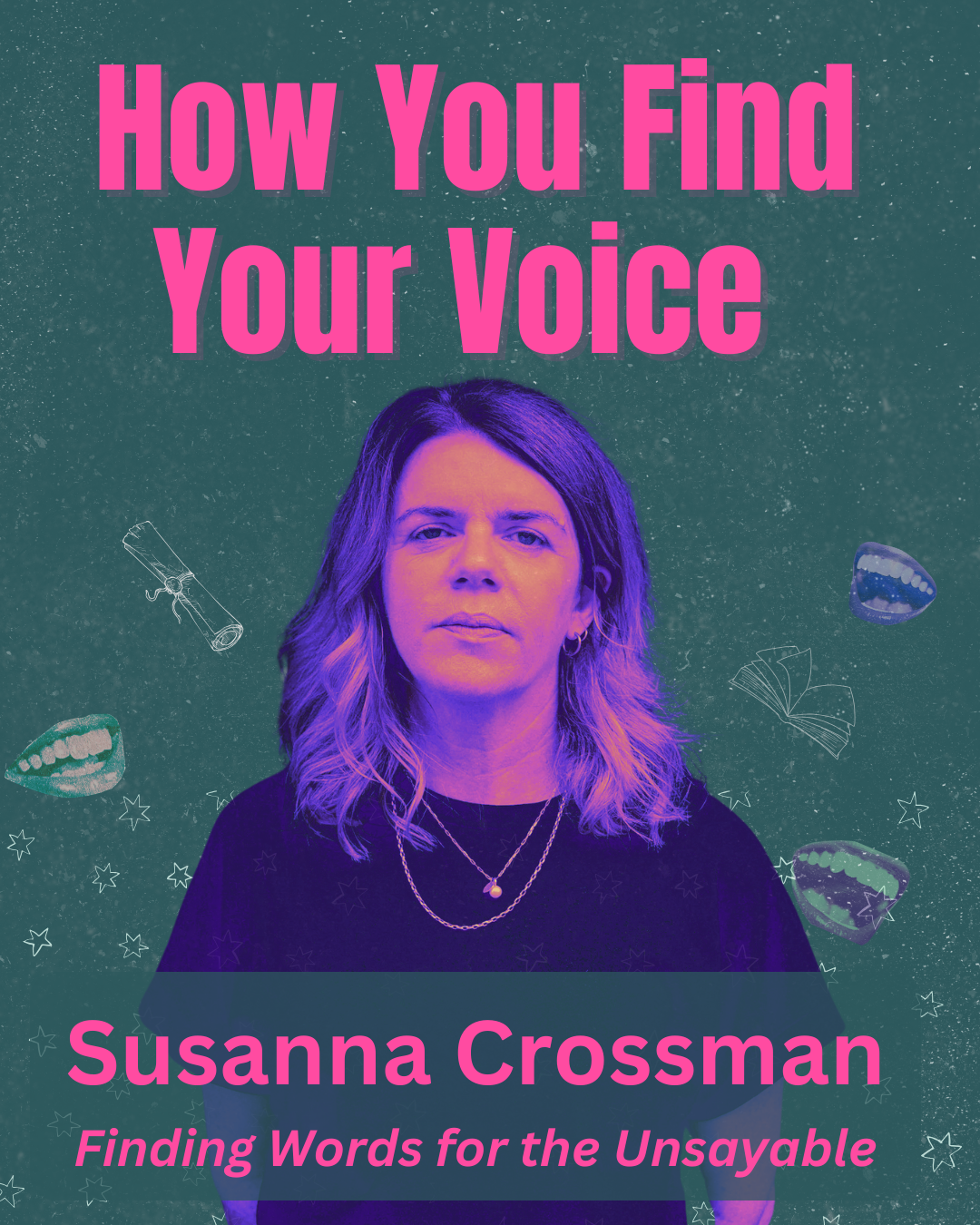
Episode 8 artwork featuring Susanna Crossman
Susanna grew up in a politically radical community in the late 1970s, a group of adults attempting to reinvent the world. Family structures were dismantled, children were raised collectively, and everything from gender roles to domestic life was reimagined.
It was, in theory, a utopia. But as Susanna describes, the reality was far more complex.
Her memoir explores what it means to come of age in that environment, and what happens when individual needs are subsumed by the collective. She speaks about the experience of growing up without clear boundaries, of learning to adapt and mask, and of internalising a script that told her everything was normal.
One of the most striking ideas in this conversation is the gap between intention and impact. The community was founded on values Susanna still believes in, but the effect on the children who grew up within it was something else entirely.
We talk about masking and people pleasing, and how growing up in that kind of environment can make it difficult to know who you are. Susanna reflects on the idea of the false self, and how the ability to adapt can come at the cost of losing touch with something more authentic.
There is also a strong thread of silence running through her work. The things that are not said, the parts of our lives we do not have language for, and the long process of finding a way to express them.
This connects deeply to her novel The Orange Notebooks, a profoundly moving exploration of maternal grief. The book follows a mother trying to make sense of the loss of her young son, and to find language for something that often feels impossible to articulate.
We talk about grief as something that resists neat narratives, and about the need to create space for what remains unresolved, chaotic and unfinished.
Language itself is central to Susanna’s work. She speaks about the importance of precision, of etymology, and of taking care with words. When we cannot find the right language, she suggests, it is a form of silencing.
This is a conversation about identity, grief, language, and the slow, often difficult process of finding your voice.
Topics Covered
• Growing up in a utopian community
• The gap between ideology and lived experience
• Collective identity versus the individual self
• Family dynamics and the dismantling of the family unit
• Masking, people pleasing and the false self
• Learning a script and unlearning it
• Silence, secrecy and untold stories
• Writing memoir as a way of understanding the past
• Finding your voice after a silenced childhood
• The importance of language and naming experience
• Grief and The Orange Notebooks
• Writing about the loss of a child
• Clinical arts therapy and working with patients
• Helping others find their voice
About Susanna Crossman
Susanna Crossman is an award-winning Anglo-French fiction and non-fiction writer, published internationally in print and online. She’s author of the the acclaimed memoir Home is Where we Start, (Fig Tree/Penguin, 2024), about her childhood in a utopian commune, a Guardian 2024 “Book to Look Out For!” Her new novel, The Orange Notebooks was published by Bluemoose Books (UK) and Assembly Press (NA) in 2025. She has recent work in The Guardian, Aeon, Vogue, Paris Review, Electric Literature & elsewhere. A published novelist in France, she was a 2022 Hawthornden Fellow, and resident at Hosking Houses Trust in 2025. Winner of the 2019 LoveReading Short Story Award, she was nominated for Best of The Net Non-Fiction and is a member of the Dangerous Women project. Susanna grew up in an international commune. Alongside her writing, she works as clinical arts-therapist on three continents, teaches and mentors writers.
Link
For more on Susanna Crossman and her books, see here.